
Well, nothing super exciting has happened in the few weeks since my last blog, but it’s a rainy day and Hugh’s out in the shed building stage 1 of the golf simulator, so I thought I’d make a cup of tea, catch you up on a few things, and share more fun Aussie creature photos and videos!
First, let’s talk crabs. As in the kind you find on the beach. A couple weeks ago, Hugh and I selected Mulambin Beach for our late afternoon walk. Remember I posted about the tall googly-eyed crabs we saw there last time and how one got annoyed with Hugh and pinched his finger? Well, we didn’t see any of those this time. But we saw HEAPS (that’s Aussie for PILES) of small crabs. Because they were small, we actually didn’t realise they were crabs at first; we just thought they were shells – until said shells started running 🙂
Here is the first video: https://youtube.com/shorts/59h99qDQFzo?feature=share. These are actually tiny, spiral shells (less than 1 cm long) – I’m just zoomed way in. We see these shells everywhere (as I’m saying this sentence in my head, I’m thinking “she sells sea shells by the sea shore”, need to check what kind of tea I’m drinking…). One of the beaches in the area is pretty much made up of these shells rather than sand. We never once considered that crabs might inhabit them – until we saw these 2 running away.
I then took this video: https://youtube.com/shorts/D8CdrpkYNFQ?feature=share. I was so focused on the larger shell that I didn’t even notice the small one until I looked at the video when I got home. So the video ends right before what looked like could be a head-on collision!!!
This video shows a much slower-moving crab: https://youtube.com/shorts/ySnoB36vYak?feature=share. Methinks he maybe picked a shell that was a little bigger than he could manage! The seagulls will be happy.
I’m assuming these are all hermit crabs of some sort and they’re picking up discarded shells, but I really have no idea. Since discovering crabs in all sorts of different shells, however, I’m wondering if I’ve previously given you false information. I’ve shared photos like this before:
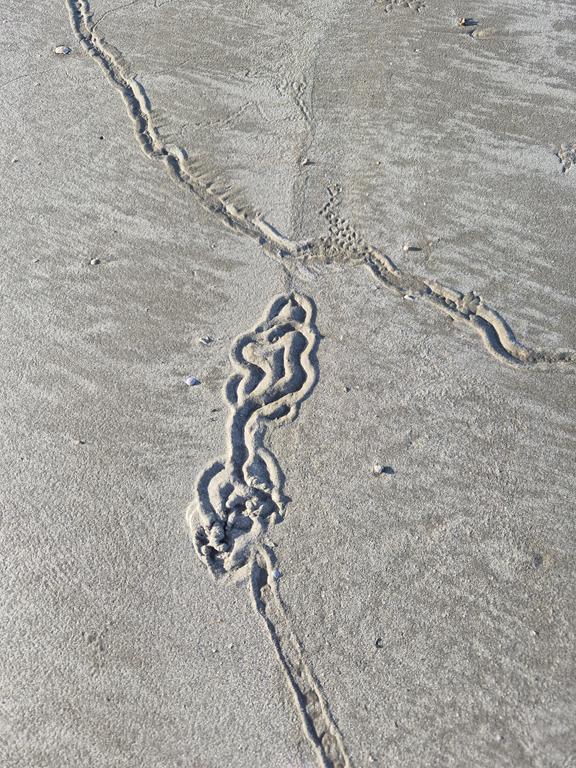
And I’ve commented on the bizarre routes that snails take when going for a walk. Now I’m wondering if the tracks are from crabs rather than snails? Or maybe both?
On that same walk on the beach, we saw these:
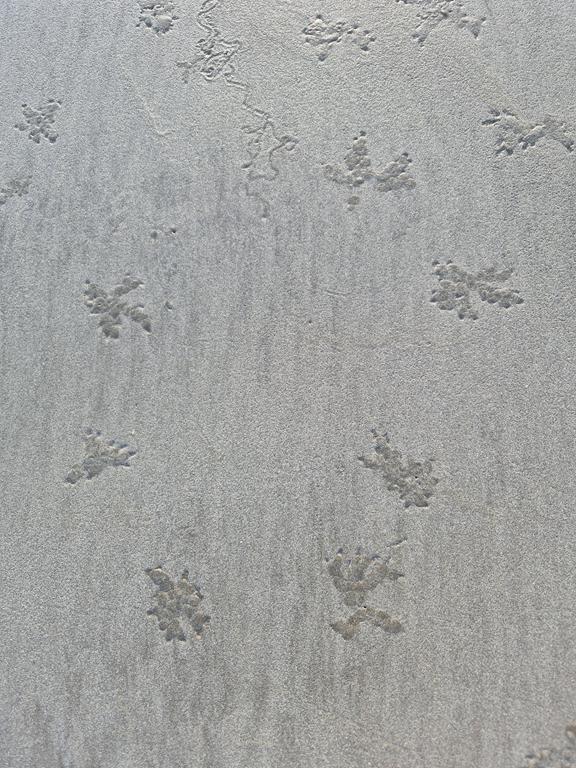
I have absolutely no idea what could be making these patterns. Aussie friends, do you know?
Also took this photo that same day:
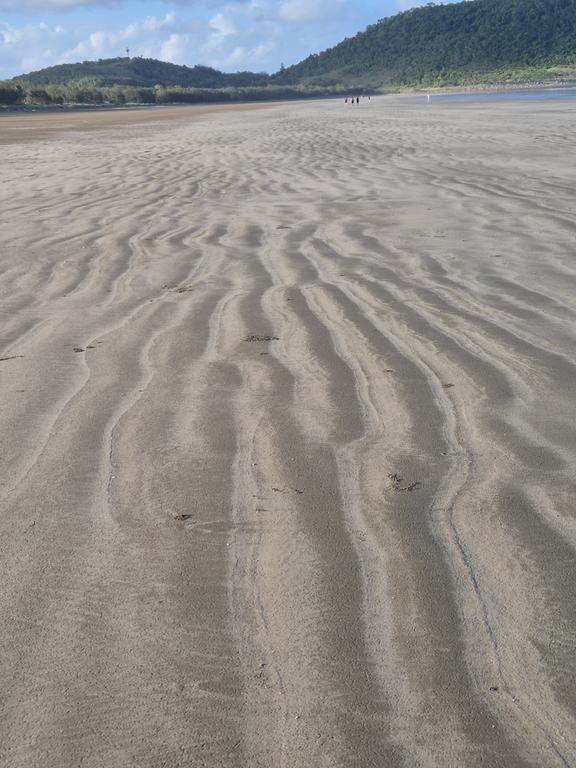
It was very deceiving. It genuinely looked like the “hills” in the sand were a couple inches high, but they weren’t even a centimeter high.
Last photo from that walk on the beach:
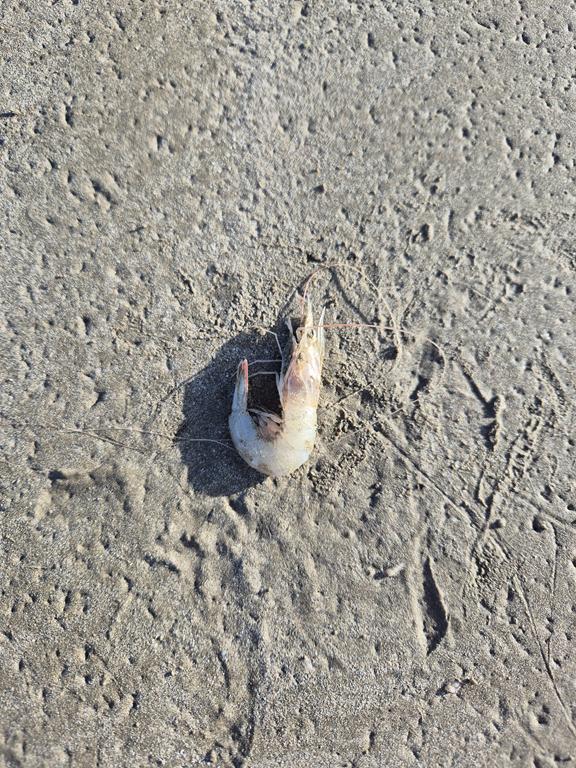
Yes, a prawn (note that this is why Aussies don’t really say “shrimp on the barbie” – because they’re called prawns here :)). Now my question about this is – could it be a prawn that was living in the sea and got blown in with all the high winds/waves we’ve had lately, or did someone drop part of their lunch on the sand?
Some updates on Aussie vocabulary for you:
- Swings and roundabouts = zero sum game / series of actions that have no net effect
- Bowser = gas pump
- Falls = rainfall totals (e.g., with falls of 100mm expected)
- Deadly = Aboriginal term meaning great/excellent (e.g., that performance was deadly)
- Pat = pet (e.g., “pat a dog”) (for some reason, this sounds so funny to me, I picture patting up and down rather than smoothing fur, and it just cracks me up!)
- The pub test, as in “would it pass the pub test” = common sense, so would a policy be considered common sense if it were discussed among average people in a pub
- Cop, as in “did you cop the hail last night” = comprehend / see / experience
- Ranga, bluey = redhead
- Fair dinkum: I’ve had this one on my list to explain to you for about 2.5 years now, but it’s been really hard to figure out. After pickleball the other week, I asked a bunch of our Aussie friends to explain it and I’m getting a better feel for it now. I also just asked Grok to get some more examples. There seem to be 2 main uses:
- Equivalent to “unreal”, for example, “They didn’t seriously do that again, fair dinkum.” In this context, I think it’s largely equivalent to another Aussie term, “far out.”
- To emphasise accuracy, honesty, authenticity, goodness, for example, “That was fair dinkum the biggest shark I’ve ever seen”, “Fair dinkum, it’s been a tough year.”, “That was a fair dinkum attempt.”, “He’s a fair dinkum Aussie.”, “That’s a fair dinkum policy.” (assuming it passes the pub test, of course :))
- Related to this is to question accuracy, for example, “She won the lottery? Fair dinkum?”
I’m still not comfortable enough with the nuances to use it myself, but I’m feeling much better about understanding it! Aussie friends, how did I do explaining it? Am I getting close?
“Chili powder” is also not what it is in North America, which we learned the hard way. Here it is just ground cayenne – nothing but cayenne. In North America it’s a blend of spices that you use when making chili. Imagine thinking it was North American chili powder when you add it to a dish – very different flavour and heat profile 🙂
Another big difference here is the use of the present perfect verb tense instead of past simple (who knew that grammar instruction in the 70’s would come in handy today!). In North America, we typically use past simple, for example: I finished my dinner, I took the dog for a walk, etc. Here you would more typically hear: I have finished my dinner, I have taken the dog for a walk. The present perfect is common in British English as well, but it is used even more here – a very prominent characteristic. It took me a while to adapt to this because present perfect in North America is very tightly tied to the current moment (as in, “I have just eaten”) whereas that’s not the case in Aussie English. I’ve now largely got my speech at work adapted to using this tense but outside of work, I think I still use past simple more automatically.
Spelling is different here too. While Canada is a mix of American and British spelling, Australia mostly follows British spelling. The biggest differences compared to Canada are:
- -ize is written -ise, as in recognise, analyse
- e vs ae and e vs oe (mostly medical terms, I think), so paediatric, oesophagus
- double l before -ing instead of single, so travelling, traveller
Because these are really important in a work context, I put myself on a spelling re-training program very early on. I now more naturally use -ise and the double vowels, and am mostly accurate with the double l. I heard back in December that Canadian Prime Minister Carney was having federal documents written in British spelling instead of Canadian spelling. Having made that conversion myself, I feel for all the bureaucrats trying to do this. It’s one thing to train yourself to do it, it’s another thing to find all the hidden places in all the various software programs to change the default so it doesn’t auto-correct incorrectly or doesn’t underline everything as being wrong! I think I now have all programs on all devices converted to Australian, but it took a couple years to find all the sneaky hiding spots for spelling defaults. Hopefully Carney allows Canadian spelling to be used – it really is a massive change to implement.
OK, I promised Birds in addition to Words, so here we go:
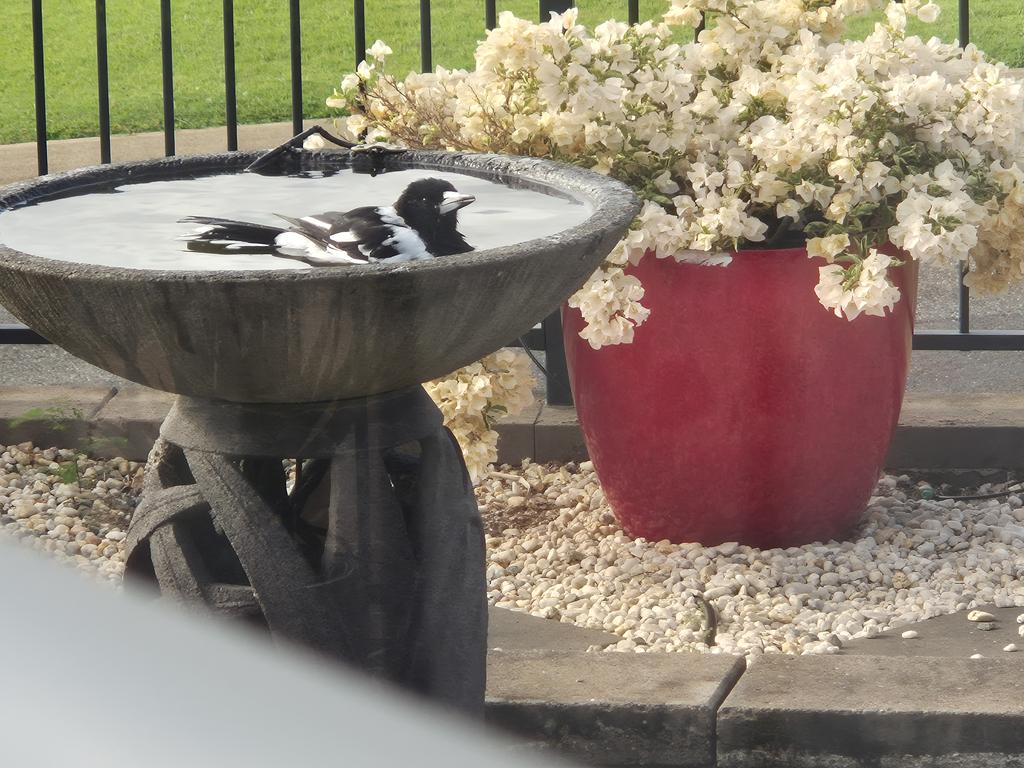
This is my favourite songbird, the Pied Butcherbird, taking a bath (and check out all the flowers on our white bougainvillea in the backgound!). We’ve always had Pied Butcherbirds around the house but for some reason, they only started hanging out around the bird bath in the last 6 months. I love having them around!
Hugh got this photo:
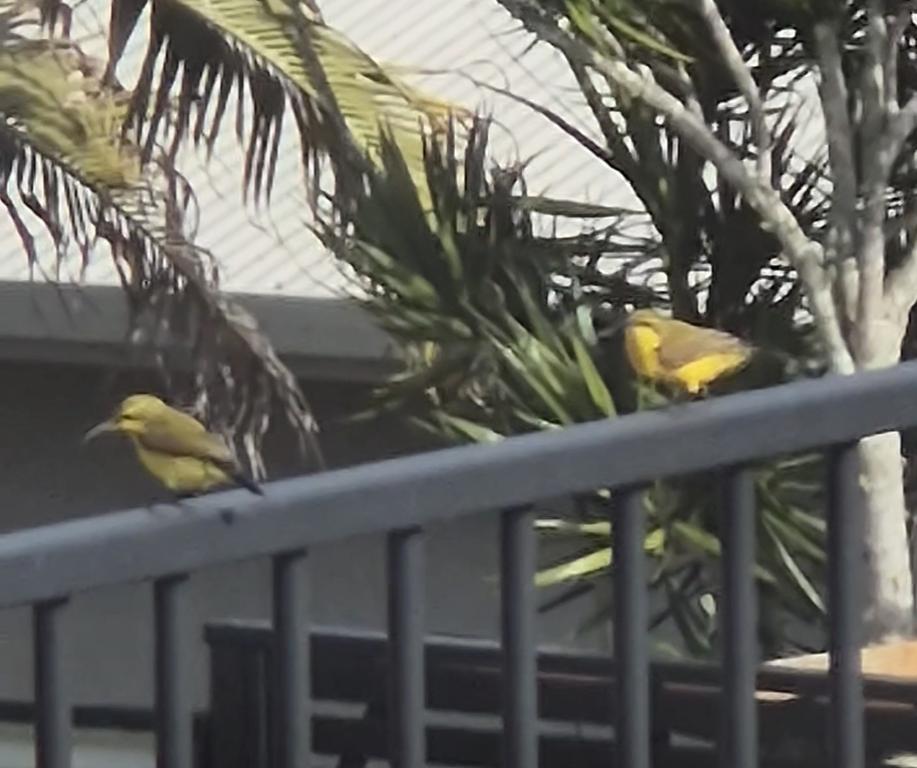
These are little Olive-Backed Sunbirds. We saw a male one when we were at Tanby Nursery one day last year (the males have a bright blue throat) but hadn’t seen the females and had never seen any at our house. They’re really cute!
Here are some crows marinating their bread in our bird bath:
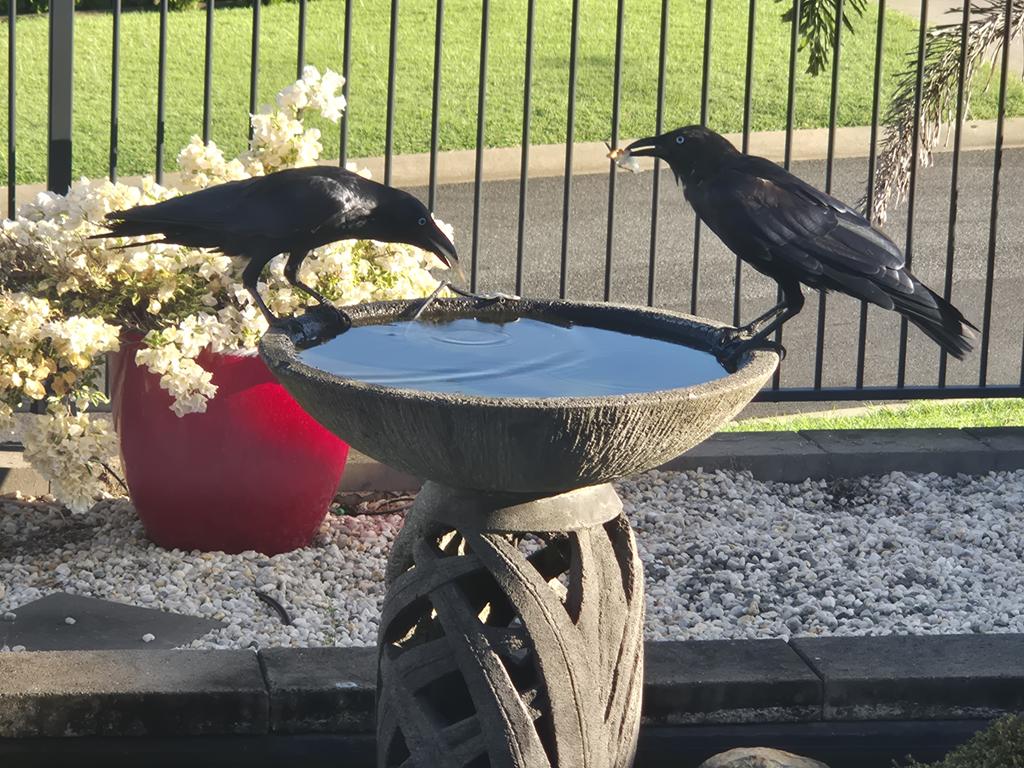
I don’t know where they get the white bread from but they certainly like bringing it over here to marinate. We’ve asked them not to and they generally comply, but not this day. Crows really are fascinating birds. We have a few brightly coloured glass stones interspersed among regular stones throughout our yard and they are very prized among the crows. The other day, a crow picked one up and another tried to get it from him, so the crow started searching for where in the yard he could hide it. He ended up tucking it under some plain stones under our lime tree. Shhh, the secret is ours.
We went to the Caves Pub for lunch a couple weeks ago (great steak and burgers, but about 45 min from here so not somewhere we’re likely to go to regularly). A magpie lark (yet another black and white bird here, but smaller than the magpies and pied butcherbirds) landed on our car and must’ve seen his reflection in the window of the car next to us and kept trying to attack the reflection. I took a video of him swooping himself a couple times here: https://youtu.be/t96Z0LgitFQ. He must have done this 10-15 times! We also noticed that he pooped on the roof of our car while he was at it.
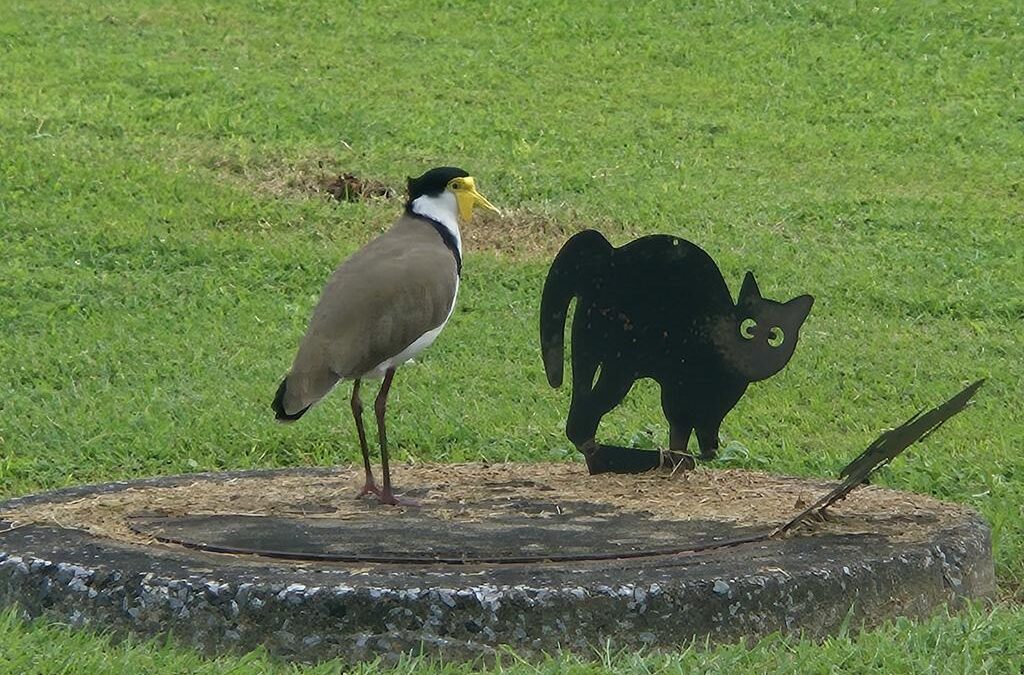
This one’s hilarious – Tavie, I think you’ll get a kick out of it! Plovers (also known as Masked Lapwings) are curious birds. They build their nests on the ground, usually close to the road or sidewalk. Then they get cranky with you if you are anywhere near them – and they have spurs under their wings to attack you (geez, plovers, just build your nest somewhere normal, like in a tree, and you wouldn’t have to deal with cars and bikes and pedestrians, sheesh!). Because of their nesting and defense habits, people try putting fake cats in their yard. One of our neighbours does this, but apparently it’s not terribly effective:
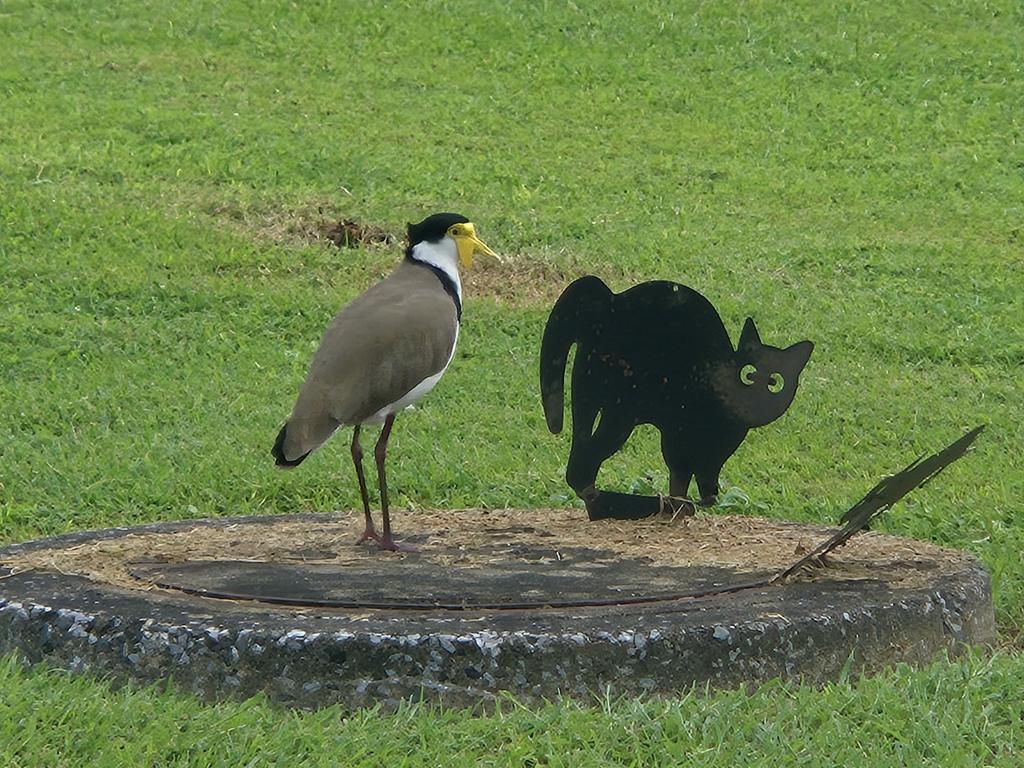
Clearly, the fake cat is more afraid of the plover 🙂
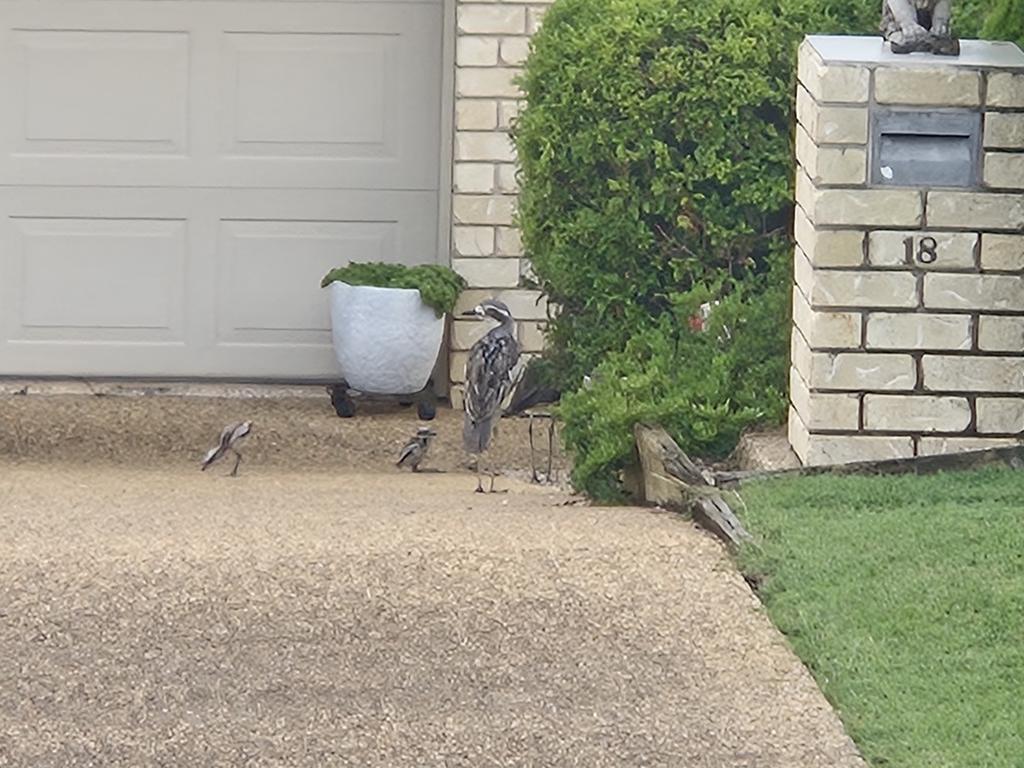
I’ve previously told you about the curlews, which I really like but others don’t (because they’re nocturnal and can sound like a woman screaming at times). Tough to get photos because they’re nocturnal, but there is a pair with 2 chicks nesting in our neighbour’s hedge and I was able to zoom in and get this photo (not great quality because I was at the top of our driveway on the other side of the street, but I didn’t want to get any closer and risk scaring them):
No more bird photos but I tried to capture just how thick/strong this spider web was:
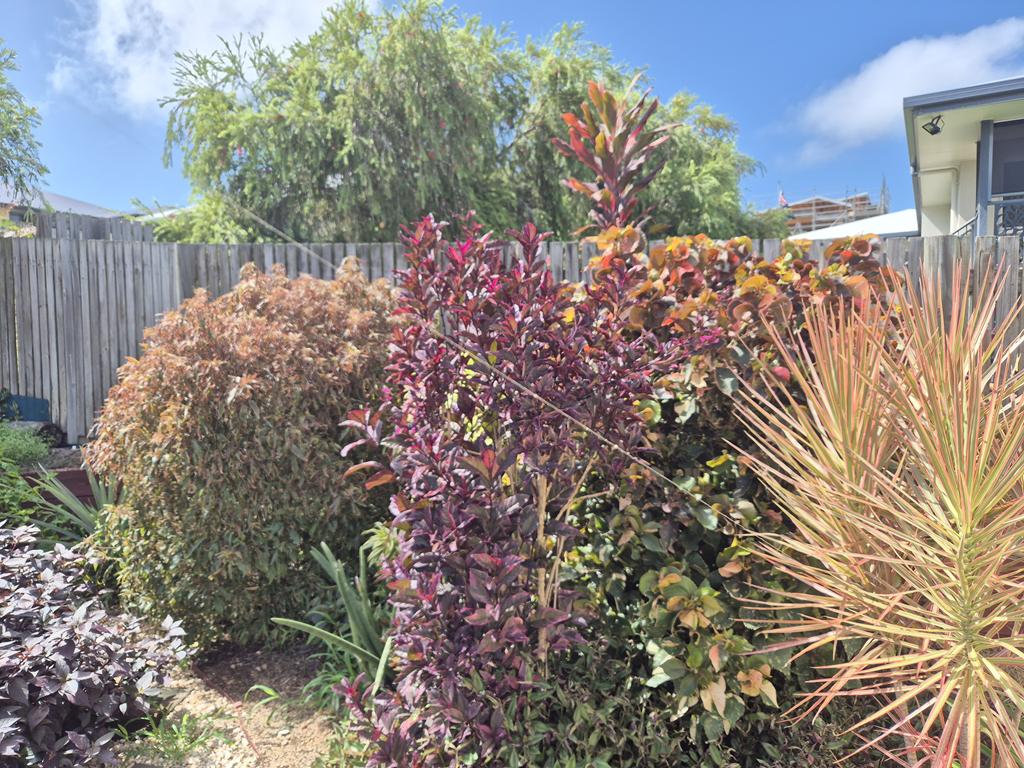
It’s made by a Golden Orb Weaver spider. The silk strands are ridiculously strong and can stretch several metres. This one was running from my clothes line to a plant in a garden next to it. I had to remove it to hang my clothes one day and you actually have to work to remove it, you can’t just wave your hand through it. Impressive!
Oh, I was leaving work the other day and a few kangaroos were hanging out under a tree next to the parking lot. By the time I realised how big they were and got my camera out, two had already hopped through the parked cars and I only just caught this one hopping by:
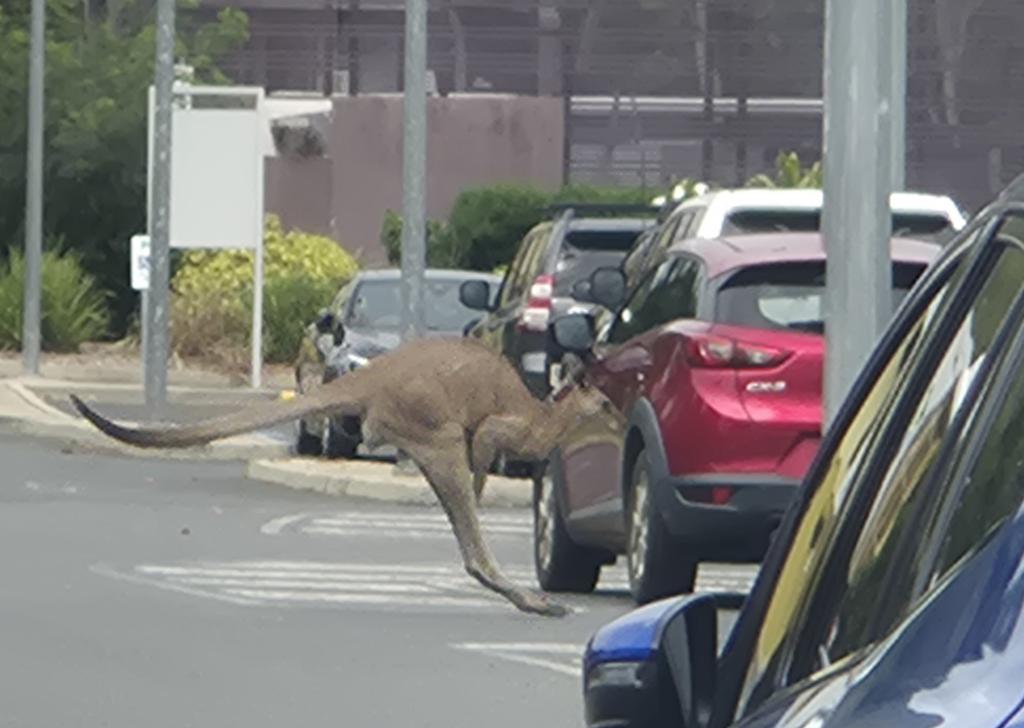
I told you about the big strong ones Hugh saw at the golf course and I think these ones were in that category too (it’s not a great photo but check out his shoulder muscles). But very funny to see kangaroos hopping through a car park 🙂 Yesterday Hugh was golfing at a course in Rockhampton with a buddy who has spent time in Canada and when the convenor announced that there was a crocodile and snakes on a section of the course, he and Hugh had a fit laughing – not an announcement you would hear in Canada!
Speaking of things you wouldn’t see in Canada – torrential downpours! We don’t get many days of rain in a year here in Central Queensland but when we do, in comes down in buckets. I took this video to show the volume of water coming out of the downspouts from our house: https://youtu.be/TwE4yU9uzAk. We are definitely built to handle massive volumes of rain. Further north, a few tropical lows are impacting areas and causing flooding, but it takes several metres of rising flood waters before there are significant negative impacts. For example, the Katherine area hit 17.5 metres yesterday (that’s almost 60 ft!) and they’re flooding, but they were in good shape when the flood waters were 30 feet.
I took a couple flower photos at work the other week. This of course is the Bird of Paradise, albeit toward the end of its bloom:
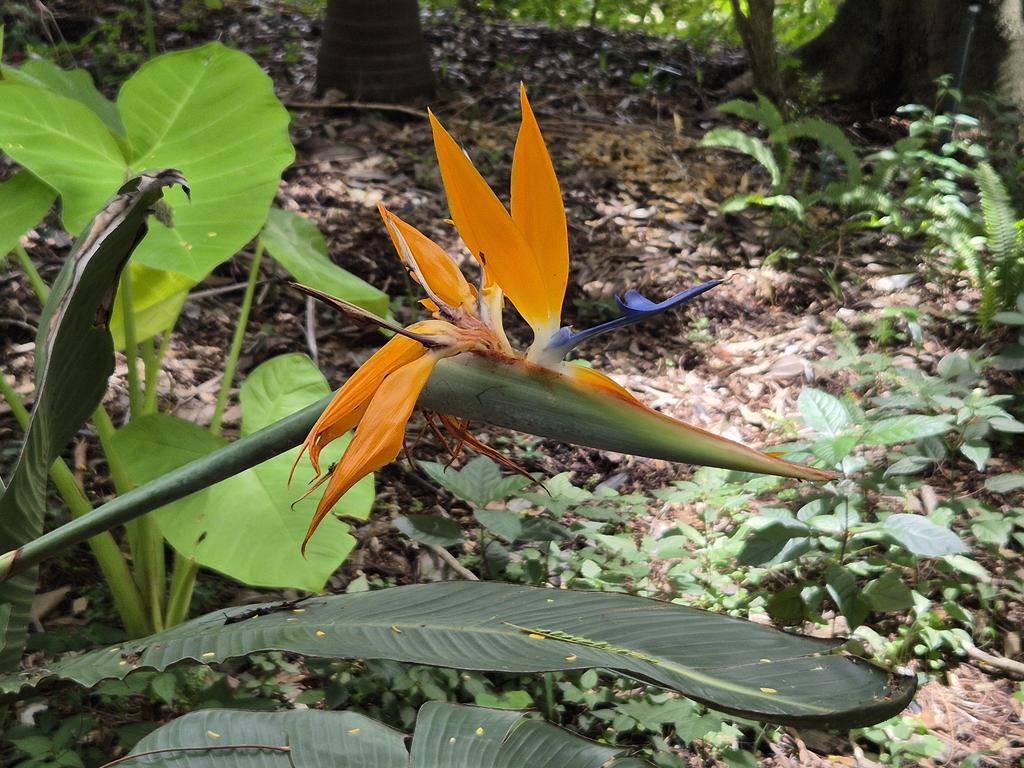
They are everywhere here but every time I see one, I think back to an episode of Happy Days where Ralph Malph got his date a Bird of Paradise corsage for the prom. A classic Ralph Malph stuff up (oh, there’s another Aussie term, instead of screw up, you say stuff up – much prefer that!).
And then there was this very funky bloom in the gardens surrounding one of the ponds on campus:
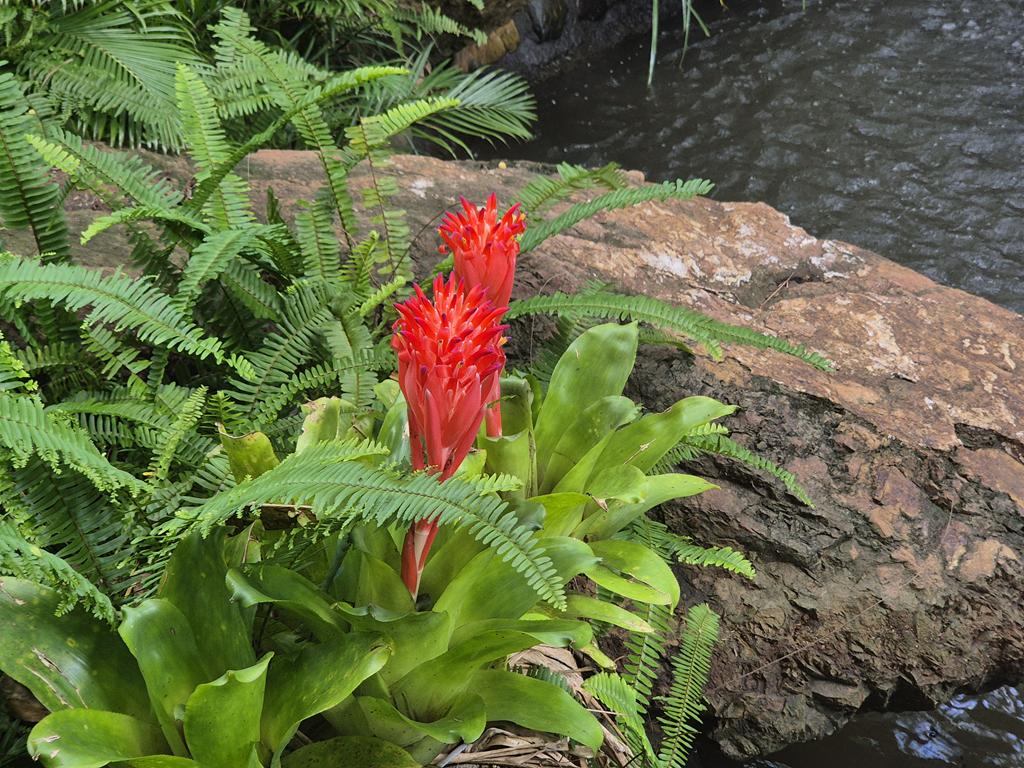
It’s a Flaming Torch Bromeliad – quite eye-catching! There are dozens (hundreds?) of varieties of bromeliads here. Many of them have razor-sharp edges to their leaves. What a shocker, another item that can maim you in Australia 🙂
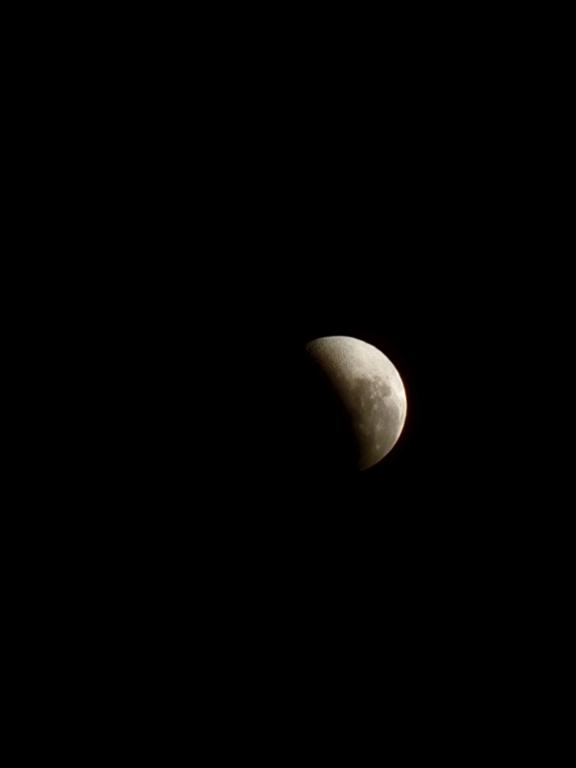
I’ve been taking an online course in photography using my Samsung phone. Many picture-framing techniques I sort of knew already, although didn’t know they were techniques, I just thought things looked better a certain way. But I’ve been learning lots of other little tips that I’ll put to use one day (I’ve created a little instruction booklet to refer to, but the reality is, I just take photos and don’t really think about it). One thing I really wanted to learn was how to take photos of the night sky because my photos always seem to be blurry. I started that module of the course but then wanted to wait to finish it until I had time at night and could try things out as it taught them. I still haven’t done that but when we had the lunar eclipse this week, I went out to see if I could get a decent photo. I tried taking a couple photos as the eclipse was beginning and the shadow was creeping up from the bottom of the moon toward the top, but they didn’t turn out. I then took one when the eclipse was full and a lovely colour of red, but it was still blurry around the edges. Then Hugh came out and indicated that I wasn’t in telephoto mode and needed to zoom more. Eureka! I hadn’t realised there was a bit of a pause/lag when you went past the normal 12x zoom and transitioned to the telephoto lens. So every time my phone stopped zooming further, I thought that was as far as it would go – wrong!! So I was then able to get decent photos as the eclipse was ending:
Excited about my new knowledge, I went out the next night to get a photo of the full moon:
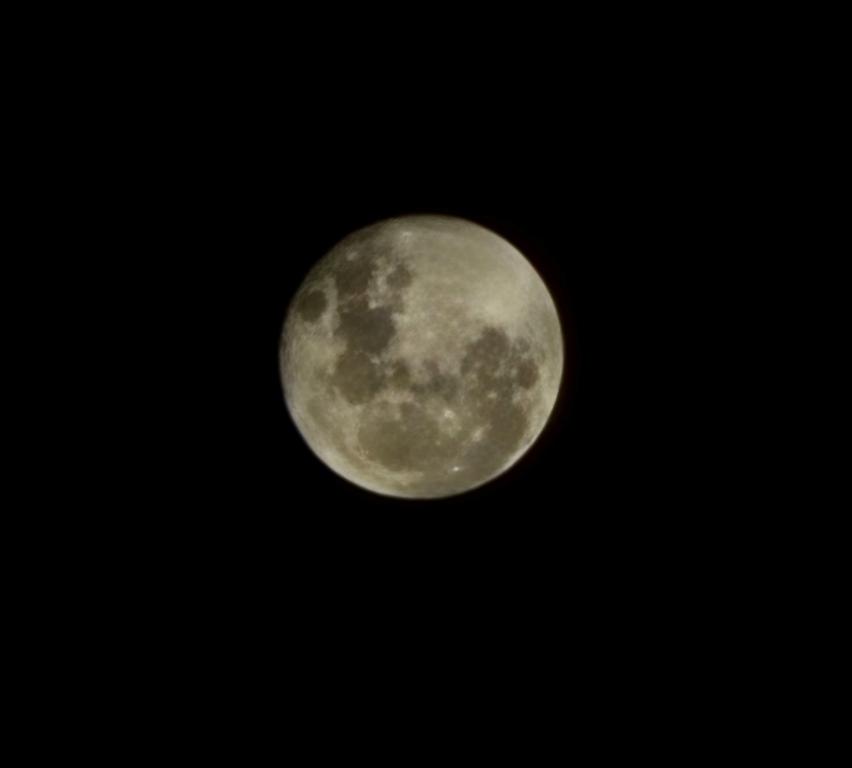
I’ve always loved looking at the night sky and now I’m stoked that I’ll be able to get better photos of it! We can see the Milky Way quite easily here so I’ll try to get a photo of that for you at some point.
We have pretty big tides in Yeppoon but after the eclipse, high tide was probably the highest we’ve seen – 5.5 metres (18 feet). My brain just does not handle 3D visual reasoning well so I still struggle to understand tides and anything related to astronomy. So I don’t try anymore, I just enjoy them!
We were excited to hear that Canadian friends are coming to visit us next February! This reminded me of this map showing when to travel to the various areas in Australia:
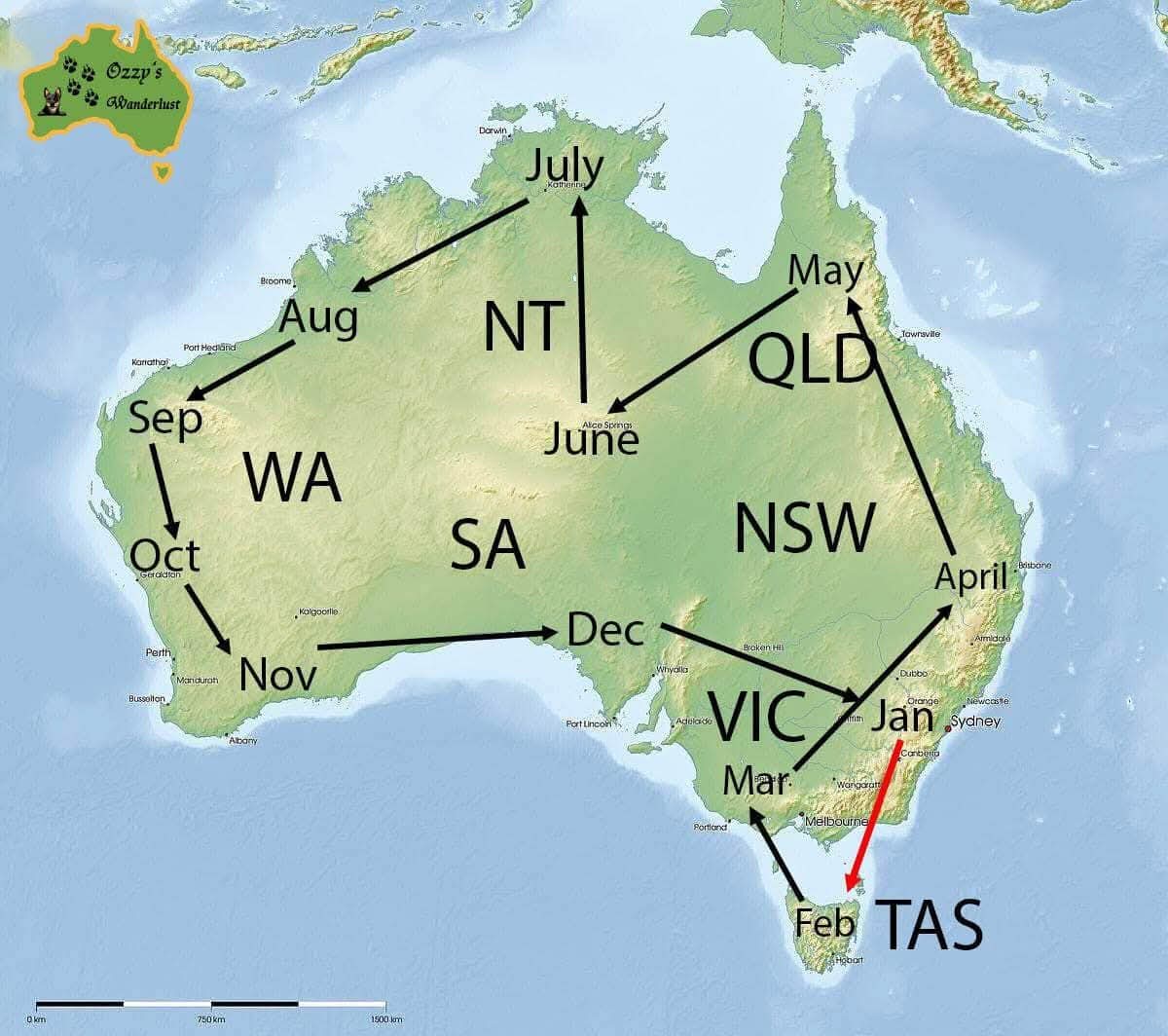
While we live in the April-May zone, the reality is it’s quite fabulous here all the time. Definitely hotter and more humid Dec-Feb, but not crushing heat and humidity like further north or crushing heat and flies in your face like further west. Probably the most important parts of the map to pay attention to are:
- Going south (Victoria, Tasmania, southern part of South Australia) in the summer (Dec-Feb) to avoid the cold and/or rainy weather you get there in winter,
- Going north (north Queensland, north Western Australia, Northern Territory) in the winter (Jun-Aug) to avoid the crushing heat and humidity and rainy/cyclone-y season,
- Avoiding the red centre (southern Northern Territory, northern South Australia, western Queensland, eastern Western Australia) in the summer so you don’t die of heat exhaustion or arm fatigue from swatting the flies away from your eyes, ears, mouth, and nostrils.
It’s been strange in the last year here – the Bureau of Meterology (BoM – same idea as Environment Canada) has started issuing heat warnings when temperatures exceed 30C. What a joke – they’re always over 30C in the summer here! And in the hotter parts of Oz, people don’t worry until heat is sustained in the high 30’s or into the 40’s. Can you imagine Arizona issuing a heat warning at 30C?!? Totally absurd. You acclimatise to the environment you’re in. I now find 15C to be very chilly and I don’t feel the need to turn the air on in the house until it hits 28C inside (and even then, only if also humid – if it’s below 60% humidity, ceiling fans are fine until it’s 29 or 30 inside). We are acutely aware of how we’ve acclimatised so we make sure to tell Canadian visitors to alert us if they find it hot so we can get the air on sooner than when we think it needs to be on.
OK, I think I’ve caught you up on a few things that have been on my To Write About list. Watching Netflix tonight then catching up on the Saturday Brier games when we wake up on Sunday morning. How about young Team Jayden King – very impressive Brier debut! And love seeing the first black skip at the Brier and the first player with cochlear implants at the Brier – terrific role models! For this year, I’m torn between cheering for Team Jacobs and Team Dunstone. Good curling, everyone!